Tuesday, August 12, 2008
Old clowns never die...do they?

This morning I got a call that Walt died. I only got a chance to meet Walt twice, when I visited his and Kaye's home. In his eighties and bent over with crippling ailments, Walt was plagued with pain. But his sense of humor was still dry as driftwood.
Walt was an aeronautical electronics wizard during the cold war. He owned a company with branches all over the world, and he and Kaye were globe trotters as he checked up on his technicians. He lived an amazing life.
In addition, Walt was a clown for the Shriners. Kaye described one clown outfit like this: ballooning silk trousers, golden slippers with toes that curled all the way back, a gaudy vest with a naked torso and a bright gemstone in his bellybutton! A favorite stunt was to walk in the parade with a piece of carpet, stopping occasionally to lay it down, sweep around it, and then gleefully sweep the dirt under the carpet.
Walt and Kaye were comedians to themselves to ease the pain of old age. Their banter was wry and self effacing, and I think they kept themselves going by poking fun at their creaking predicament. As a couple, they were unique. May God receive Walt into his arms of mercy.
-


Sunday, August 10, 2008
Hydroplane racing in Silverdale

Yesterday I went to the Port of Silverdale to watch the final race of the Silverdale Thunder hydroplane races. The photo above is from the Kitsap Sun article in this morning's paper about the race.
Thinking theologically, where is God in hydroplane racing? I'm not sure, but I'll offer some thoughts.
Hydroplane racing is a lot like stock car racing. It's noisy, thrilling, and dangerous. The boats go so fast that they literally become airborne, fluttering and bouncing over the surface of the water, barely in control. One boat even flipped. Yesterday's winner averaged over 94 miles an hour.
There was a good crowd of various ages at the waterfront park, and I would say it was similar to the crowd at a stock car race. Beer gardens seemed to be the most popular vendors.
The race was somewhat confusing to watch, even with an announcer giving a relentless moment-by-moment account of the action. The boats leave the dock several minutes before the start of the race, and they throttle around the buoys jockeying for position. At the appointed time, they begin racing in earnest, throwing up great sprays of water as they skitter around the curves and barrel down the straightaways.
The winner was a woman, 20-year-old Kayleigh Perkins of Issaquah. Even in traditional male venues like hydroplane racing, women have shown their determination to succeed.
Hydroplane boats are fueled by enormous engines using high-test fuel. Blown engines and high fuel bills are just part of the business. The sponsors of the boats tend to be hard-working blue-collar firms (think Graham Trucking).
So...speed, power, danger, noise, and consumption. It's a cultural phenomenon that came out of the late twentieth century. But as petroleum costs continue to escalate and we begin to value quietness, efficiency, and a smaller carbon footprint (or wake), I wonder what the future of hydroplane racing will be?
After all the fuss is over, I'll put my kayak in the water at the same dock the hydroplanes used. But I'll navigate the waters silently, under human power.
Friday, August 8, 2008
The opposite of faith

What is the opposite of faith? Normally we think it would be doubt. If faith is about believing something in your mind, then the opposite would be not believing, or doubting.
But the Gospel lesson for Sunday seems to say that the opposite of faith is fear. Peter asks Jesus to command him to walk on the water. Jesus says, "Come."
Then, it says, "Peter got out of the boat, started walking on the water, and came toward Jesus. But when he noticed the strong wind, he became frightened, and beginning to sink, he cried out, "Lord, save me!"
It was Peter's fear that made him sink. As long as he walked in faith, he could do anything. But when he became frightened, he began to sink.
When we have faith in God, we have no fear because we know we're doing God's will. Whatever should happen to us will be of no consequence as long as we're being faithful to God. Faith is trust in God. We trust God to take care of us. And when we trust God, God can use us for his purposes.
The problem is that it's very hard to trust God for all our needs. We want to be in control, and as soon as we're in control, we're trusting ourselves instead of God. Then we fall through the waves of fear.
I would like to live in complete trust, but I always find myself falling back and trying to be in control again. It's not so easy living in faith!
Thursday, August 7, 2008
Stepping out in faith
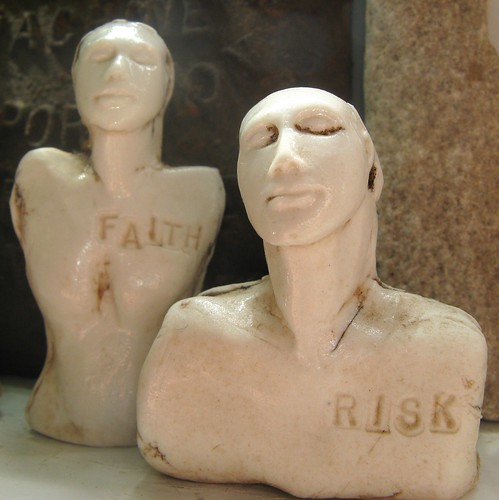
In the Gospel lesson for Sunday, Jesus came walking across the sea to the disciples who were struggling in the boat. When Peter saw Jesus walking on the water, he asked Jesus to command him to step out of the boat and walk on the water. What a risk!
I've always thought Peter was being foolish by asking this. Why not stay safely in the boat? But good old impulsive Peter just had to try walking on water. He took a risk to be with Jesus.
Sometimes it's good to take a risk. Often we become paralyzed because we fail to take a risk, and we lose the opportunity to step out in faith.
Last March, Katy and I agreed we would move to Silverdale and put our house in Florence up for sale, hoping it would sell at a decent price. It's still on the market. We took a risk that it would work out OK, and we stepped out in faith. I hope our house sells soon!
Peter's audacity is a good example for me. Sometimes you just have to step out of the boat in faith. The good news is that God will catch you if you fall.
-
Tuesday, August 5, 2008
A prophet in crisis

In the Old Testament lesson for next Sunday, Elijah is a prophet in crisis. He has run away from everything because he feels persecuted and unappreciated. He has found shelter in a cave and now he's sulking.
God speaks to him in the cave. He says, "Elijah, what are you doing here?"
Elijah pouts, "Everyone is out to get me. It's all your fault that I'm so miserable."
God tells him to go out and stand on the mountain, because he is going to pass by. Elijah doesn't go out. He's pouting. So God sends a great wind, so great that it hurls boulders off the mountain. No response from Elijah. Then God shakes the earth with a great earthquake. No response. Then God sends a fire that rages over the mountain. Still Elijah sulks. He's not coming out.
Then God sends a silence. This silence is so deep and so profound that even Elijah knows that it is God. He comes out.
God says a second time, "Elijah, what are you doing here?"
And Elijah says the same thing, word for word, that he said the first time. But this time it sounds silly and unconvincing. "Everyone is out to get me."
God says to Elijah, "I'm taking all the responsibility off you. Go now, run away from this place and give the mantle of responsibility to Elishah and Jehu and Hazael. You're free now. I take this burden from you."
And starting on this day, Elijah becomes a man of utter peace, beyond all suffering and all strife. Even when he dies, he is taken up to heaven in a chariot because death can't get hold of him.
-
Monday, August 4, 2008
The Pirates of Penzance at CSTOCK

Last night Katy and I went to see the Pirates of Penzance at our local community theatre, CSTOCK. The performers were all youth from this area, and what talent they have! The singing was strong and precise, the acting was marvelously farcical, and the choreography was effortlessly graceful.
We saw several parishioners in the audience, and they told us how kids from all over Kitsap County come here to be in these productions. The hard work and dedication of these kids clearly showed, and I would guess that the directors must love their work and these kids. All together it was an excellent performance, filled with zest and joy.
The wonderful thing about community theatre is it's realness. These are our local kids, and the performance is live and right in front of us. It's so direct and real. We loved the expressions on the kids faces, especially the youngest performers.
In the Gospel of John, Jesus says, "I have said these things to you so that my joy may be in you, and that your joy may be complete." (John 15:11)
When we stood for the standing ovation at the end of the performance, we saw real joy. Surely Jesus would love this.
-
Friday, August 1, 2008
The meaning of the Barn Sale

Today is the first day of our annual Barn Sale. Many hours have been spent in preparation for this yearly rummage extravaganza, and the effort is paying off. The parking lot is full of vehicles of people who have come to poke through the tables of carefully priced merchandise.
What I'm wondering is, "What's the theological significance of the Barn Sale?" Or, to put it another way, "Where is God in all this?" Here are my ideas:
1. Healing the world. The profits from the Barn Sale will go to our Outreach Fund which distributes money to non-profit organizations that help people.
2. Evangelism. There are people driving into our parking lot who may return. Just finding out where we may be the beginning of someone's renewed faith journey. The Barn Sale is a big part of our community awareness.
3. Fellowship. Preparing for an event like this and pulling it off takes an immense amount of teamwork, and when everyone pulls together, it bonds people together.
4. Stewardship of the planet. By recycling used goods, we reduce the amount of waste that goes into the landfills and we reduce the amount of resources and energy used to make new goods.
The mission of our church is "to be one people of God who gather in worship and go forth to proclaim the Gospel and serve the world." In our own way, we're proclaiming the Gospel and serving the world through the Barn Sale.
-
Subscribe to:
Posts (Atom)